Level 4 · Upper intermediate · Story
和奶奶一起过暑假
Holidays with grandmother
Odongo and Apiyo leave the city to spend the summer holidays with their grandmother in a fishing village by a big lake.
🔑 Key words in this story (24)
- 渔村 yúcūn fishing village
- 前往 qiánwǎng to go to, to head for
- 第二天 dì'èrtiān the next day
- 睡着 shuìzháo to fall asleep
- 家里 jiālǐ home
- 回到 huídào to return to
- 蔬菜 shūcài vegetables
- 村子 cūnzi village
- 期待 qīdài to look forward to
- 靠近 kàojìn close to, near
- 湖泊 húpō lake
- 行装 xíngzhuāng things packed for a trip, luggage
- 踏上 tàshàng to set out on (a journey)
- 旅程 lǚchéng journey
- 睡不着 shuìbuzháo can't get to sleep
- 凌晨 língchén early morning, before dawn
- 山丘 shānqiū hill
- 看到 kàndào to see
- 野生 yěshēng wild
- 茶园 cháyuán tea plantation
- 车辆 chēliàng vehicle
- 到达 dàodá to arrive, to reach
- 叫醒 jiàoxǐng to wake (someone) up
- 树荫 shùyīn shade of a tree
Tap any word for its meaning.
欧东格、
Odongo and Apiyo lived in the city with their father. They looked forward to the holidays. Not just because school was closed, but because they went to visit their grandmother. She lived in a fishing village near a large lake.
欧东格
Odongo and Apiyo were excited because it was time to visit their grandmother again. The night before, they packed their bags and got ready for the long journey to her village. They could not sleep and talked the whole night about the holiday.
第二天
Early the next morning, they left for the village in their father’s car. They drove past mountains, wild animals and tea plantations. They counted cars and sang songs.
过
After a while, the children were tired and fell asleep.
当
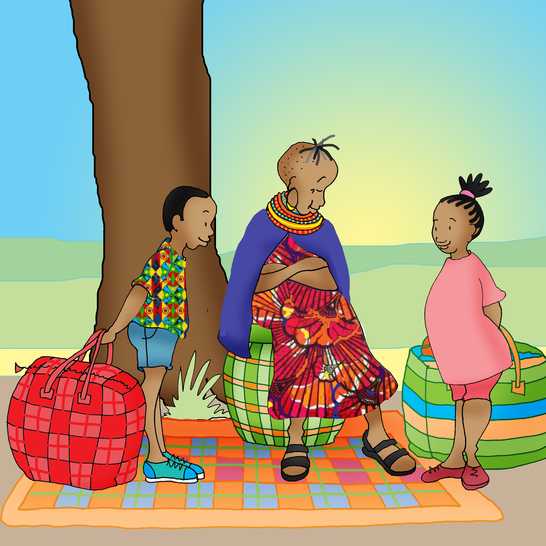
Father woke up Odongo and Apiyo as they arrived in the village. They found Nyar-Kanyada, their grandmother, resting on a mat under a tree. Nyar-Kanyada in the local language means ‘daughter of the people of Kanyada’. She was a strong and beautiful woman.
尼亚·
Nyar-Kanyada welcomed them into the house and sang and danced with them joyfully. Her grandchildren were excited to give her the presents they had bought in the city. Odongo and Apiyo each clamoured for her to open their gift first.
尼亚·
After she opened the presents, Nyar-Kanyada blessed her grandchildren in a traditional way.
欧东格
Then Odongo and Apiyo went outside. They chased butterflies and birds.
他们
They climbed trees, jumped into the lake and splashed in the water.
天黑
When it was dark they returned to the house for dinner. But they were so tired that before they could finish eating, they were falling asleep!
第二天,
The next day, the children’s father drove back to the city leaving them with Nyar-Kanyada.
欧东格
Odongo and Apiyo helped their grandmother with household chores. They fetched water and firewood. They collected eggs from the chickens and picked greens from the garden.
尼亚·
Nyar-Kanyada taught her grandchildren to make soft ugali. She showed them how to make coconut rice to eat with roast fish.
一
One morning, Odongo took his grandmother’s cows to graze. They ran onto a neighbour’s farm. The farmer was angry with Odongo. He threatened to keep the cows for trampling his crops. After that day, the boy made sure that the cows did not get into trouble again.
有
On another day, the children went to the marketplace with Nyar-Kanyada. She had a stall selling vegetables, sugar and soap. Apiyo liked to tell customers the price of items. Odongo would pack the items that customers bought.
这
At the end of the day they drank chai tea together. They helped grandmother to count the money she earned.
很
But too soon the holidays were over and the children had to go back to the city. Nyar-Kanyada gave Odongo a cap and Apiyo a sweater. She packed food for their journey.
当
When their father came to fetch them, they did not want to leave. The children begged Nyar-Kanyada to go with them to the city. She smiled and said, “I am too old for the city. I will be waiting for you to come to my village again.”
欧东格
Odongo and Apiyo both hugged her tightly and said goodbye.
当
When Odongo and Apiyo went back to school they told their friends about life in the village. Some children felt that life in the city was good. Others felt that the village was better. But most of all, everyone agreed that Odongo and Apiyo had a wonderful grandmother!