Nói lái: the Vietnamese art of speaking backwards
2026-07-31 · Idiomer
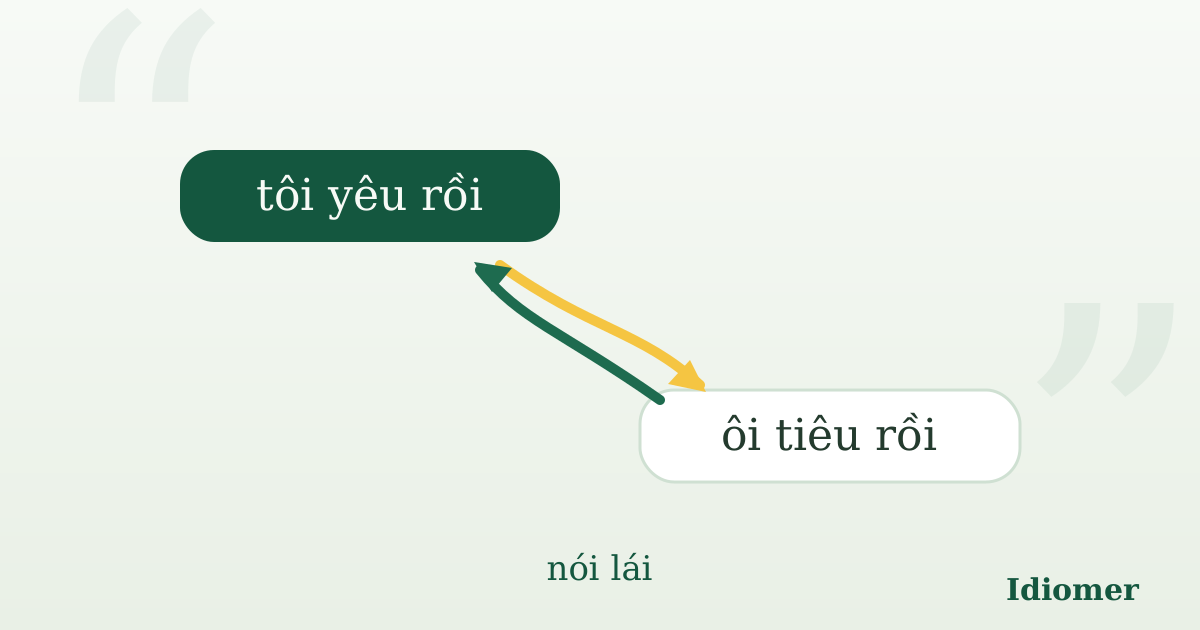
Say "tôi yêu rồi" (I'm in love) to a Vietnamese friend and they might grin and answer "ôi tiêu rồi" — oh no, you're done for. Same three syllables, sounds swapped. That's nói lái, the Vietnamese spoonerism: a word game so embedded in the language that it powers proverbs, poetry, courtship, and an entire genre of jokes about being careful what you name your shop.
How it works
A Vietnamese syllable has three separable parts: the initial consonant, the rhyme, and the tone. Nói lái swaps exactly one (or two) of those layers between a pair of syllables:
- Swap the rhymes: bồ của mình (my sweetheart) → bình của mồ
- Swap the initials: tôi yêu → ôi tiêu
- Swap the syllables but leave the tones behind: nhớ em rồi (missing you already) → rối em nhờ — the tones of positions one and three stay exactly where they were
Because the swaps are precise and reversible, a listener can decode the joke instantly — and so can software. Idiomer's search does it automatically: search for hại điện and you'll get hiện đại back, labeled as nói lái. There's also a nói lái machine where you can type any phrase and watch it flip.
When wordplay becomes vocabulary
Most lái is invented on the spot and vanishes just as fast. But some pairs were too good to let go, and became fixed expressions in their own right:
- Hiện đại nhưng không hại điện — "modern but not power-hungry," the eternal gadget joke.
- Đơn giản như đang giỡn — "easy as kidding around," where the two halves are lái of each other.
- Bật mí bí mật bị mất — a lái chain about revealing the lost secret.
- Chà đồ nhôm — "scrubbing the aluminium," which decodes to chôm đồ nhà: pilfering from your own house. The lái IS the euphemism.
- Đấu tranh thì biết tránh đâu — "if you struggle, where do you hide?" — folk-verse fatalism built on a perfect swap.
The whole family lives in the nói lái topic.
Why learners should care
First, comprehension: Vietnamese speakers deploy lái constantly, and no dictionary lookup of ôi tiêu rồi will help you if you don't recognize the transform. Second, phonological awareness: to play nói lái at all, you have to hear syllables as initial + rhyme + tone — which is exactly the skill that makes Vietnamese pronunciation click. Practicing the decode is practicing the sound system.
English has spoonerisms too, of course — but they're accidents named after a clumsy Oxford don. Vietnamese made them a national sport. Take a phrase you know, run it through the nói lái machine, and see what the language hides in plain sight.
Want these phrases to stick? Drill them with endless practice questions →